Tracking a source
Everything in Definitions works in the ground frame: an array
pointed at alt 70°, az 180° stays pointed there whatever the hour. Real
sources rise and set, so Observation ties the
ground frame to a site and a time and converts a sky position into the
alt/az pair divergent_pointing() takes. A
configuration chosen once therefore does not stay the configuration in
force all night:
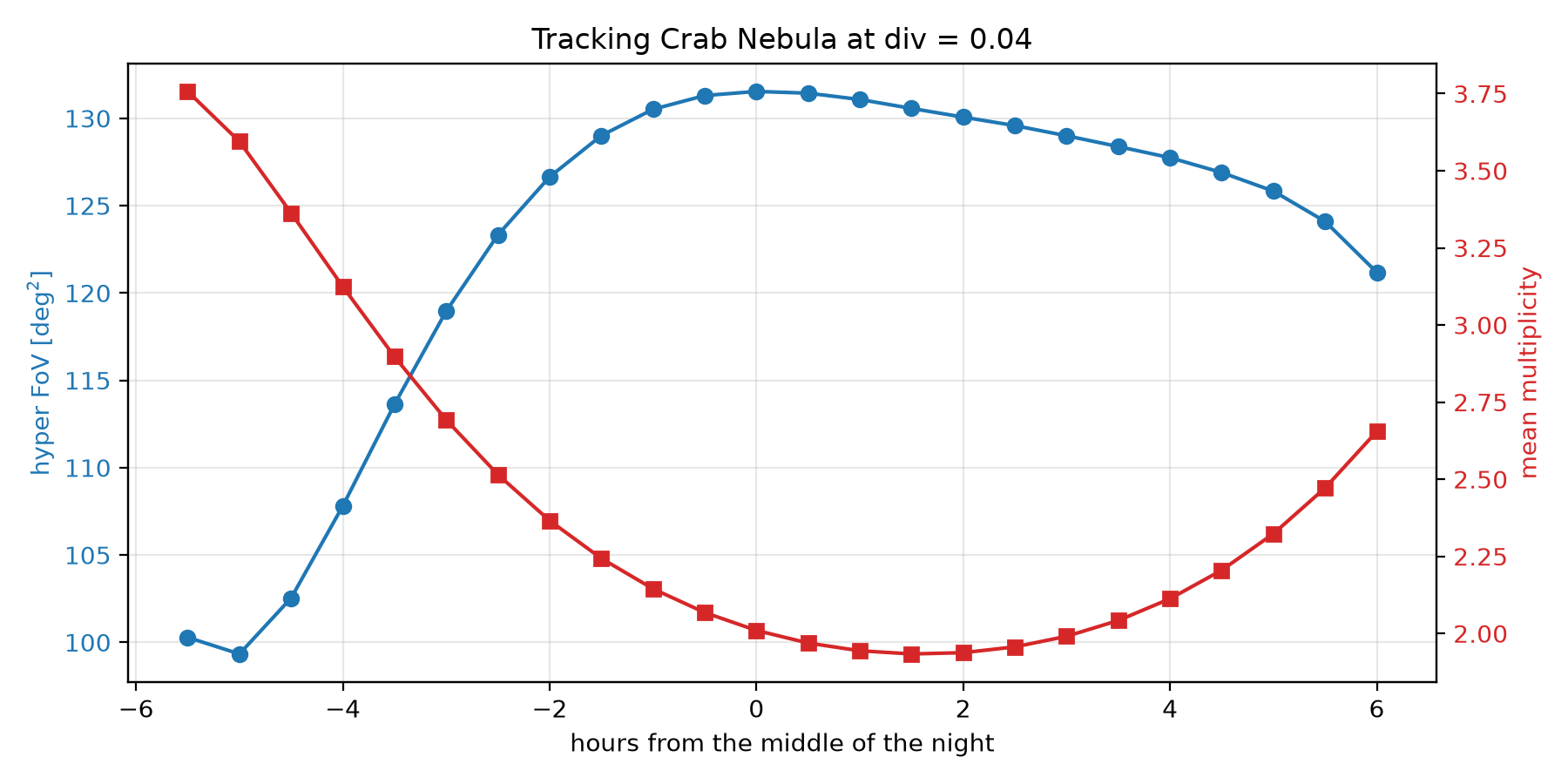
CTAO-North tracking the Crab Nebula at a fixed div = 0.04. Over eleven
hours the stereoscopic footprint moves between 100 and 132 deg², and the
mean multiplicity crosses the stereoscopic floor of two twice, once on
either side of transit — because the same altitude is reached rising and
setting. A configuration picked at the start of the night is not the
configuration a fixed div gives at the end of it; matching one to the
other means re-pointing during the night, not choosing div once.
Try it yourself
The plot above is one fixed div, read off at a handful of hours. The
notebook behind it lets you change any of that: pick a different source,
site or night, drag div, and step through the night hour by hour to
see the sky map update. It opens on the same array and source as the plot
above — CTAO-North, the Crab Nebula, div = 0.04 — on a night chosen so
the source stays up for the whole window, so the first thing it shows is
that same trade-off, before you touch anything.
Open the demo in its own tab for the full-screen version.
This runs on a Python interpreter compiled to WebAssembly: nothing is
installed, no code leaves your machine. It is built from
examples/marimo/observing_a_source.py; run or edit it locally with
marimo edit examples/marimo/observing_a_source.py.